
A platform for integrated drug discovery and translation
When Lawrence Einhorn, MD, developed the cure for testicular cancer in the early 1970s, he gave hope to thousands of patients around the world and inspired countless cancer researchers to develop other therapies that might one day cure other cancers.
In 2019, IU Simon Comprehensive Cancer Center launched the Cancer Drug Discovery and Development Accelerator (CD3A) initiative, with the goal of integrating emerging technologies/equipment and computational tools for new drug discovery and development.
The CD3A is an initiative of the cancer center with the goal of accelerating drug discovery and development by bringing together university researchers, experienced pharmaceutical industry veterans, technology cores, and external research organizations.
Led by program co-leaders Chafiq Hamdouchi, PhD, and Mark Kelley, PhD, our primary focus is expanding accessible molecular space and drug development capabilities across and within our research cores.
For cancer center members
Our mission is to accelerate your drug discovery research and transform it into groundbreaking treatments for cancer patients. Contactus today to learn more about CD3A resources and how to apply for project support.
For industry and other academic centers
We collaborate with industry and other academic centers to accelerate the development of novel cancer therapies. Partner with us to access experienced CD3A advisors with over 325 years of pharma know-how and co-create partnering strategies.
Chafiq Hamdouchi, PhD, chhamd@iu.edu Co-Leader, Cancer Drug Discovery and Development Accelerator Program Senior Research Professor, Department of Pathology & Laboratory Medicine, IU School of Medicine Adjunct Professor, Department of Clinical Pharmacology, IU School of Medicine

Mark R. Kelley, PhD, mkelley@iu.edu Co-Leader, Cancer Drug Discovery and Development Accelerator Program Associate Director of Basic Science Research, IU Simon Comprehensive Cancer Center Betty and Earl Herr Professor in Pediatric Oncology Research, IU School of Medicine

Crystal Baker, crybanks@iu.edu CD3A Translational Research Coordinator & Project Manager, IU Simon Comprehensive Cancer Center

Targeting PIM2 and its Regulation of the c‐Myc Oncogene in Multiple Myeloma and Other Cancers
Multiple myeloma (MM) is a malignancy of plasma cells that is the second most common hematologic malignancy (20% of all cases) and remains incurable for almost all patients. The primary cause of treatment failure is upregulation of pro‐survival resistance mechanisms. Identifying these mechanisms remains key for any new therapeutic development.

Dr. Lee, et al. have shown that the serine‐threonine kinase PIM2 has a major prosurvival role in MM, and that their first‐in‐class PIM2‐selective, non‐ATP‐competitive allosteric inhibitors demonstrated significant MM cell death in vitro and were efficacious in preclinical in vivo xenograft models of MM. Their findings suggest a completely novel mechanism where their drug candidates disrupt a PIM2 interaction with a partner protein, resulting in downregulation of c‐Myc expression and loss of c‐Myc driven PIM2 gene expression.
The team is currently in the Lead Optimization phase, conducting advanced characterization of their drug candidates with the aim of identifying and developing potent, selective, and orally bioavailable PIM2 modulators whose preclinical efficacy, safety, and pharmacokinetic profiles will enable clinical exploration of efficacy and safety in patients with multiple myeloma and other cancers.
Team Science: Elliot Androphy, MD
Targeting HPV-16 E6 Protein
Cervical cancer is one of the leading world causes of cancer morbidity and mortality in woman, with more than 98% related to a human papillomavirus (HPV) infection origin.

Over the past four years, with support of grants from Indiana University Health, the Indiana Drug Discovery Alliance, IU Simon Comprehensive Cancer Center and the National Cancer Institute/NIH, Elliot Androphy, MD, (Dermatology) collaborated on a project to develop small molecules that inhibit the HPV-16 E6 protein by combining structure based drug design, medicinal chemistry, and development of new biochemical and cellular assays. Inhibition of this viral protein stops HPV replication and induces death of HPV-expressing cells. After multiple iterations of design and testing, their novel compounds show significant anti-tumor activity in xenotransplantation experiments. Such a breakthrough provides a unique opportunity for the treatment of women with cervical HPV infections including cancer in situ, all populations with anal and genital HPV-16 infections, and cancers of the oropharynx, cervix, anal canal, and genitalia due to HPV-16. HPV induced cancers cause 4.5% of all malignancies worldwide and lead to the death of > 600,000 people annually.
Dr. Androphy, along with Dr. Zhijian Lu, are co-founders of Kovina Therapeutics Inc.
Team Science: Mark Kelley, PhD
Nearly three decades of dedication by Mark Kelley, PhD, led to the development of APX3330, a molecular compound that targets a protein important to the development of several types of cancer.
In 2009, Dr. Kelley translated this discovery into a start-up company called Apexian Pharmaceuticals.
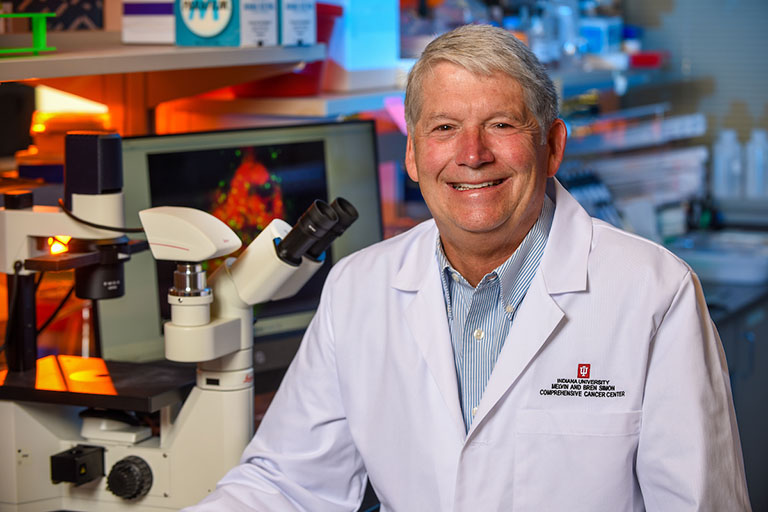
In the last 30 years, Kelley has disclosed 61 inventions, been awarded 19 patents and licensed three of his innovative technologies to other companies.
Targeting the APE1/Ref-1 protein with second generation inhibitors
Dr. Kelley and his collaborators, are targeting the APE1/Ref-1 redox signaling and DNA repair protein for a variety of cancers including pancreatic, sarcoma, colon and other solid tumors. AP endonuclease-1/Redox factor-1 (APE1/Ref-1 or Ref-1) is a multifunctional protein that is overexpressed in most aggressive cancers and impacts various cancer cell signaling pathways. Ref-1’s redox activity plays a significant role in activating transcription factors (TFs) such as NFκB, HIF1α, STAT3 and AP-1, which are crucial contributors to the development of tumors and metastatic growth. The development of potent, selective inhibitors to target Ref-1 redox function is an appealing approach for therapeutic intervention. A first-generation compound, APX3330 successfully completed phase I clinical trial in adults with progressing solid tumors with favorable response rate, pharmacokinetics (PK), and minimal toxicity. These positive results have prompted the team to develop more potent analogs of APX3330 to effectively target Ref-1 in a variety of cancers. A number of the new compounds are in the Lead Optimization phase.
Some Frequently Asked Questions about the Cancer Drug Discovery & Development Accelerator (CD3A)
Q: What was the foundational vision behind establishing CD3A, and how does it address unmet needs in academic drug discovery?
A: The foundational vision for CD3A was to bridge the "valley of death" in drug development, that critical gap between a promising scientific discovery in the lab and its successful application as a patient therapy. It specifically addresses unmet needs in academic drug discovery by providing the funding, specialized industry knowledge, and structured partnerships that researchers often lack. The program was designed to de-risk early-stage projects and accelerate the translation of novel cancer therapies to patients who need them.
Q: How does CD3A strategically integrate university researchers, pharmaceutical industry veterans, and technology cores to maximize synergistic outcomes?
A: CD3A functions as a collaborative hub that strategically brings together several key groups to work in synergy.
The program includes:
University researchers and clinicians who provide foundational scientific innovations.
Experienced pharmaceutical industry veterans with more than 325 years of combined experience who have contributed to more than 25 FDA-approved drugs.
Internal Indiana University technology cores, along with external Contract Research Organizations (CROs) that offer specialized resources needed to conduct experiments to industry standards.
This model enables CD3A to form custom-tailored project teams that collaboratively develop a successful clinical path for each unique innovation.
Q: What are the primary translational barriers that CD3A aims to dismantle, and what unique mechanisms does it employ to accelerate this process?
A: The primary barrier CD3A dismantles is the "valley of death," where promising academic discoveries often stall due to a lack of resources and industry-specific expertise.
To accelerate the process, CD3A uses several unique mechanisms:
A Structured Development Roadmap: CD3A uses an established, industry-standard roadmap that guides projects from the early "target-to-hit" stage through IND-enabling studies. This helps identify potential hurdles early and de-risks the development path.
Expert Guidance and Disciplined Selection: The accelerator is guided by seasoned drug developers who use a rigorous screening process to ensure only the most promising and technically feasible projects are advanced.
Validated Resources: CD3A provides access to a network of high-quality internal IU cores and external CROs to ensure data is reliable and milestones are met efficiently.
Q: How does CD3A define and measure success beyond traditional academic metrics?
A: CD3A measures success with tangible, outcome-driven metrics that reflect its progress in moving therapies toward the clinic.
Key indicators include:
A Robust Project Pipeline: The program has supported more than 50 drug discovery projectsand has a 15% IND application rate, which is significantly above average for academic centers.
Specific Deliverables: Success is measured by key outputs, including six new leads, one pre-clinical candidate, and one clinical candidate.
Intellectual Property and Commercialization: The program has seen about 20% of its projects result in startups.
External Grants: The program has assisted investigators in obtaining more than 15 external grants, including grants from the NCI and Mark Foundation.
Patient Impact: The goal is to improve patient outcomes by accelerating the development of novel treatments for diseases such as multiple myeloma and HPV-induced cancers.
Q: Can you provide examples of how artificial intelligence or other computational tools are being leveraged within CD3A?
A: Yes, integrating emerging technologies is a core part of CD3A's strategy. The program leverages artificial intelligence (AI), machine learning, and other advanced computational methods to enhance various stages of the drug discovery process. These tools are used to improve the efficiency of tasks like target identification, lead optimization, and predicting a drug's efficacy.
Q: How does CD3A accelerate the drug development timeline?
A: CD3A fast-tracks discovery by operating like a biotech within a comprehensive cancer center. It unites IU scientists, pharma seasoned leaders, core facilities, and CROs into one team,‑ replacing slow hand-offs with end-to-end execution. Lean, streamlined governance lets projects pivot or progress in days, not months. Starting from well-validated biological targets, one of IU’s strengths further reduces false starts and rework. Result: cleaner data sooner, fewer cycles, and faster progression from target to lead to IND-enabling‑ studies, compressing timelines that often take years in traditional models.
Q: How does CD3A reduce the cost of drug discovery and development?
A: CD3A lowers costs by concentrating spend on science, not overhead. Unlike big pharma, it operates leanly; budgets are allocated to experiments rather than layers of management. By utilizing IU cores and best-fit CROs on demand, it avoids the need to build expensive infrastructure and benefits from competitive pricing. Strong front-end target validation and early kill criteria prevent investment in weak assets, the biggest driver of late, costly failure. Streamlined program management shortens cycle time, and every month saved reduces vendor and team burn. Net effect: more progress per dollar and a lower total cost to reach lead, candidate, and IND milestones.
Q: How does CD3A navigate intellectual property and commercialization strategies?
A: CD3A's strategy is designed to advance discoveries while building a self-sustaining financial model for future research. A key output of the program is the creation of new intellectual property. To commercialize these innovations, CD3A actively creates licensing opportunities, start-ups, and partnerships with pharmaceutical and biotech companies. To ensure equitable benefit sharing, researchers agree to allocate a portion of future commercialization proceeds (like royalties or license fees) back to CD3A, creating a "virtuous cycle" of funding and innovation.
Q: What mentorship or talent development opportunities does CD3A offer?
A: While CD3A isn't a degree-granting program, it plays a vital role in cultivating talent in drug discovery and development. The program provides researchers with invaluable mentorship opportunities within its collaborative framework. It also offers specific entrepreneurship training to prepare scientists to become biotech leaders and engage with commercial investors. In addition, CD3A investigators participate as mentors in the NIH-supported T32 Pediatric and Adult Translational Cancer Drug Discovery and Development Training Program (PACT-D3), which provides structured mentoring and career development for trainees interested in translational cancer drug discovery.
Q: What are the long-term goals and expansion plans for CD3A?
A: CD3A's long-term goal is to become a national model for academic drug discovery and to create a self-sustaining financial model where returns are reinvested to support future projects. The program is built to support a broad therapeutic reach, including modalities like small molecules, biologics, cell therapies, and RNA-based treatments. It also targets a wide range of cancers. The future focus is to continue expanding this portfolio to solidify the IU Simon Comprehensive Cancer Center's role as a leader in cancer innovation.
Q: What truly differentiates CD3A's model from other traditional academic drug discovery programs?
A: Several key aspects differentiate CD3A's operational model:
Deep Industry Integration: CD3A is distinguished by its robust integration of seasoned pharmaceutical executives and their real-world experience. Its advisors have contributed to more than 25 FDA-approved drugs, providing unparalleled insight.
Explicit Translational Focus: While traditional programs often focus on basic research, CD3A is an "accelerator" with the primary goal of translating discoveries to clinical proof of concept.
Industry-Standard Roadmap: It uses a clearly defined, milestone-driven development path that is a hallmark of the pharmaceutical industry.
Outcome-Driven Metrics: The program's success is measured by tangible deliverables like drug candidates and IND filings, not primarily by academic publications.
CD3A: Cancer Drug Discovery and Development Accelerator
Transforming Scientific Discovery into Clinical Impact – From Bench to Bedside
Introduction & Differentiation
Who We Are
CD3A is uniquely positioned to address one of the most persistent bottlenecks in oncology drug development: translating discoveries from academic research into viable clinical therapies. We provide the infrastructure, expertise, and resources needed to progress early-stage research to clinical proof of concept.
Our mission is powered by a dual lens—academic innovation and commercial strategy—allowing CD3A to identify transformative science and develop it with a path to real-world impact. We help Indiana University's scientific community realize the full therapeutic potential of their ideas.
CD3A’s location within the Indiana University Melvin and Bren Simon Comprehensive Cancer Center means it benefits from the cancer center’s integrated cores, shared facilities, and expert faculty. Our projects are not only scientifically rigorous—they are also clinically relevant and execution-ready.
This seamless interface between laboratory science and patient care ensures that the therapies we help develop align with actual clinical needs and can transition quickly into testing environments.
The Cancer Drug Discovery and Development Accelerator (CD3A) is a fully integrated drug discovery and development platform embedded within the IU Simon Comprehensive Cancer Center —Indiana’s only NCI-designated comprehensive cancer center. Our unique model combines academic excellence with pharmaceutical discipline to drive cancer drug projects from initial disease identification to clinical proof of concept. With a mission to accelerate high-impact oncology research into effective therapies, CD3A represents a bold new paradigm in academic drug development.
What Makes CD3A Different
Academia + Pharma Synergy: Co-led by IU researchers and pharmaceutical veterans who have contributed to more than 25 FDA-approved drugs.
Embedded in IU Simon Comprehensive Cancer Center: Direct access to oncologists, patients, and clinical trial infrastructure enables rapid translation from bench to bedside.
Oncology-Only Focus: Deep expertise in solid and hematologic malignancies allows for precision-driven development.
End-to-End Capability: Comprehensive support from target validation to IND filing and clinical proof of concept.
Each CD3A project begins with a collaborative mapping session involving principal investigators, CD3A advisors, and development scientists. Together, we chart a customized pathway from bench to clinic, incorporating all key success factors—from biomarker validation to formulation strategies.
Beyond project guidance, CD3A acts as a trusted advisor, helping researchers understand regulatory expectations, commercial market dynamics, and investor interest. This 360-degree support significantly increases the probability of success for high-risk, high-reward projects.
In addition to our core offerings, CD3A also supports:
Competitive grant writing and co-investigator inclusion
Startup formation strategy and investor pitch development
Access to AI-driven modeling platforms for hit identification and lead design
"CD3A is helping us take discoveries all the way to our patients—something few academic centers can do." — Dr. Kelvin Lee, director, IU Simon Comprehensive Cancer Center
These metrics underscore CD3A’s role as a catalytic force in the IU innovation pipeline. Our projects span multiple cancer types and therapeutic modalities—including small molecules, biologics, peptides, and RNA therapeutics.
Model, Services & Impact
Our Model: Seamless Integration
CD3A bridges the gap between academic innovation and commercial readiness. Our teams include 325+ years of collective drug development experience, connecting IU faculty with CROs and pharma experts to co-create targeted roadmaps for each project.
Our Services
Few institutions in the country offer this level of integration between basic science, translational expertise, and clinical execution. CD3A is not a passive support service—it is an active, outcome-driven accelerator that reduces risk and increases speed across the board.
Drug Discovery & Development Functions:
Target Identification & Validation
Screening & Hit Discovery (HTS, DEL, Fragments, Rational Design, Computer-Assisted Drug Design)
Medicinal Chemistry & SAR (Lead Generation and Optimization)
Structural Biology & Computational Chemistry
Biology & Mechanism of Action Studies
Preclinical Pharmacology (in vitro / in vivo efficacy models)
Preclinical ADME/PK & Toxicology (discovery and GLP-enabling studies)
Formulation & Scale-up (CMC readiness)
Biomarker Development & Translational Sciences
Regulatory & IND Strategy
Clinical Trial Design & Proof of Concept (POC)
Alliance & Program Management
Intellectual Property (IP)
Modalities Supported:
Small Molecules
Peptides & Proteins
RNA-based Therapeutics
Monoclonal Antibodies (mAb)
Cell Therapies (e.g., CAR-T)
Impact by the Numbers
50+ oncology projects supported
15% IND filing success rate
~20% projects led to startups
16 grant-supported project through CD3A
To scale our impact, we are actively developing sustainable financial models involving equity positions in startups, milestone-based licensing terms, and reinvestment of royalty income. This blended strategy ensures that early philanthropic investments yield long-term financial and therapeutic returns.
Success Stories & Value Proposition
Clinical Pipeline Highlights (See more information about these projects under “CD3A team science examples”)
PIM2/cMYC Inhibitors: Novel oral therapies for multiple myeloma in partnership with P2K Dynamics.
Ref-1/APX Series: Second-generation compounds for pancreatic and eye cancers.
HPV Inhibitors: Full-spectrum development support for Kovina Therapeutics’ clinical candidates.
Unique Value Proposition
Integrated pharma-academic development under one roof.
Clinical trials on-site at IU Simon Comprehensive Cancer Center.
Tailored development paths for each project.
Speed, quality, and cost-efficiency unmatched in academia.
Sustainability, Support & Vision
Funding Model
CD3A’s hybrid funding approach includes philanthropy, research grants, startup equity, and royalties. This model ensures long-term sustainability while fueling bold, early-stage research.
Join Us
Your partnership accelerates breakthrough cancer therapies. Together, we can shorten the path from discovery to cure.